
HVAC work splits into two main worlds: residential and commercial. A residential tech works in homes. A commercial tech works in offices, stores, schools, and other buildings. The trade is the same at the core, but the day looks very different in each world.
Many techs work in one world their whole career. Some move between the two. Knowing how each one runs helps a new tech pick a starting point and helps an experienced tech judge a move.
Residential work
Residential work is in houses, townhouses, and small apartment buildings. The equipment is furnaces, air conditioners, heat pumps, and water heaters. Most jobs are one or two pieces of equipment in one home.
The tech deals directly with the homeowner. Every call starts with a conversation in someone’s living room, and the tech explains the problem and the fix to a person who is not in the trade. Good communication matters as much as good hands.
Days are made of many short calls. A tech might run five or six calls in a day, with driving time between them. On-call rotation is common, and the busy seasons are summer for cooling and winter for heating. A heat wave or a cold snap can turn a normal week into long days.
Commercial work
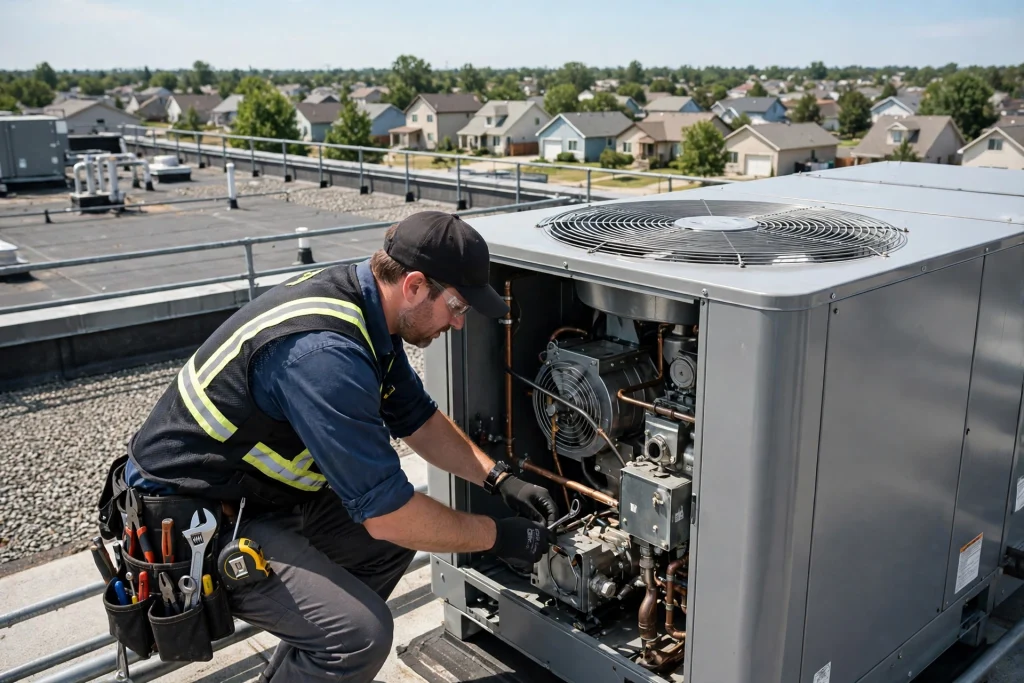
Commercial work is in larger buildings. The equipment is rooftop units, boilers, chillers, air handlers, and split systems that serve whole floors or whole buildings. Jobs are bigger, and a single call can take a whole day or more.
The tech deals with a building operator, a property manager, or a maintenance supervisor, not the person sitting at the desk. Work is often done under a service contract, with scheduled maintenance visits and a set response time for breakdowns.
Days have fewer calls and longer jobs. A tech might spend a full day on one rooftop or one boiler room. Travel can be wider, covering a whole city or region. Work is steadier through the seasons because commercial buildings need heating and cooling all year, though summer and winter are still the busiest times.
Positives of residential work
The work is varied. Every house is different, and the tech sees a lot of different equipment and problems in a week. Homeowners who are happy with the work often become repeat customers and refer neighbours. Smaller companies can mean a short drive and a familiar area. A tech who likes people and likes explaining things will enjoy the customer side of the job. Starting a small residential company of your own is simpler than starting a commercial one.
Negatives of residential work
The pace is fast and the driving adds up. Evenings and weekends on call can eat into family time, especially in peak season. Some homeowners are hard to deal with, and the tech has to handle that on their own in the home. The work is seasonal, so a mild summer or a mild winter can mean fewer hours. Pay can be lower than commercial work in some areas, and benefits depend on the company.
Positives of commercial work
The systems are bigger and more interesting to a tech who likes complex equipment. Jobs are longer, so there is time to diagnose properly instead of rushing to the next call. Service contracts mean scheduled work and steadier hours through the year. Pay and benefits are often stronger, especially with larger companies. There is more room to specialize, in chillers, controls, boilers, or refrigeration, and specialization usually pays better.
Negatives of commercial work
The work is physically harder in some ways: rooftops in summer heat and winter cold, ladders, and long days on your feet. Travel can be long, and a tech can spend a lot of the day driving between sites. The customer is a building operator with a contract, so the pressure is on response time and paperwork as much as on the repair. Getting into commercial work can be harder for a new tech, since companies often want experience first. Some jobs are in dirty or noisy plant rooms.
Skills that transfer
The core skills are the same in both worlds. Electrical testing, reading wiring diagrams, checking airflow, and working through a system step by step are used every day in a house and on a rooftop. A tech who learns those skills well can move between residential and commercial work. The equipment changes size, but the thinking does not.
Which fits whom
Some techs like the variety and the people side of residential work. Others like the bigger systems and steadier schedule of commercial work. Some techs start residential to learn the basics fast, then move to commercial for the larger equipment and the pay. There is no wrong order, and a move in either direction is common.
Related posts
- Voltage: how to read voltage on a live control circuit.
- Blower Motor: how the blower moves air through a system.
- Thermostat: how the control calls for heat and cooling.