
A lot of technicians treat Temperature Difference (TD) and Delta T (ΔT) as if they mean the exact same thing. They do not.
Using them interchangeably in the field will lead to misdiagnosing airflow issues, setting up the wrong box humidity, or condemning parts that are working fine.
Here is the straightforward distinction:
- Delta T (ΔT) is the temperature drop across a single medium as it passes through a heat exchanger (such as air entering versus leaving an evaporator coil).
- TD (Temperature Difference) is the temperature difference between two different mediums transferring heat (such as the air entering the coil versus the refrigerant boiling inside the coil).
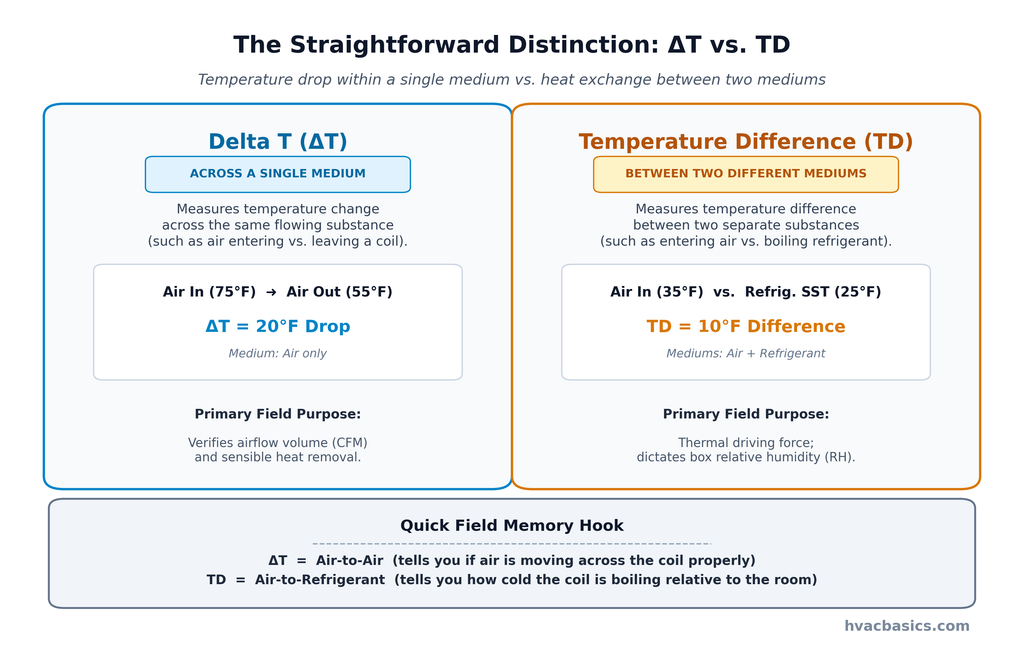
Delta T (ΔT): The Air-Side Drop
Delta T simply means “change in temperature.” In air conditioning and refrigeration, Delta T almost always refers to the air temperature drop across the coil.
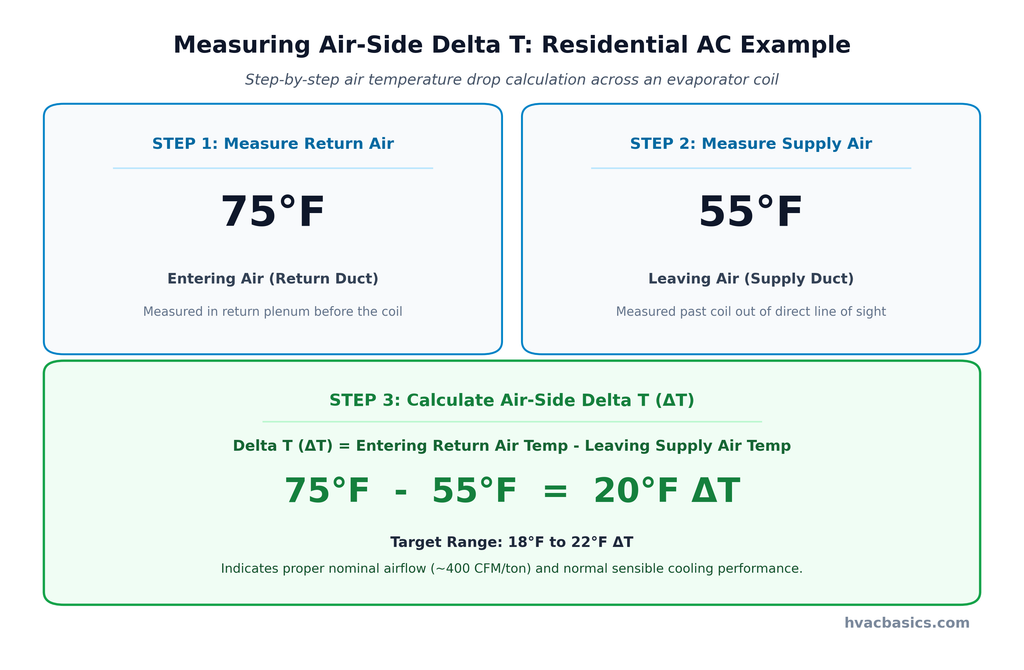
ΔT = Entering Air Temperature – Leaving Air Temperature
Residential AC Example
- Return air entering the evaporator: 75°F
- Supply air leaving the evaporator: 55°F
- ΔT = 75°F – 55°F = 20°F ΔT
Walk-in Cooler Example
- Box air entering the evaporator fans: 35°F
- Supply air blowing out of the coil: 28°F
- ΔT = 35°F – 28°F = 7°F ΔT
What Delta T Tells You
Delta T tells you how much sensible heat the air is giving up right now. It is your primary check for airflow:
- High Delta T: Usually points to low airflow (dirty air filter, iced coil, slipping belt, undersized ductwork). The air stays in contact with the cold coil longer, so its temperature drops further.
- Low Delta T: Usually points to excessive airflow, a starved evaporator (low charge or restricted metering device), or high latent load (lots of moisture condensing out, which consumes capacity without dropping the thermometer reading quickly).
Evaporator TD: The Heat Transfer Driving Force
In refrigeration work, when someone says “the TD of the coil,” they mean Evaporator Temperature Difference.
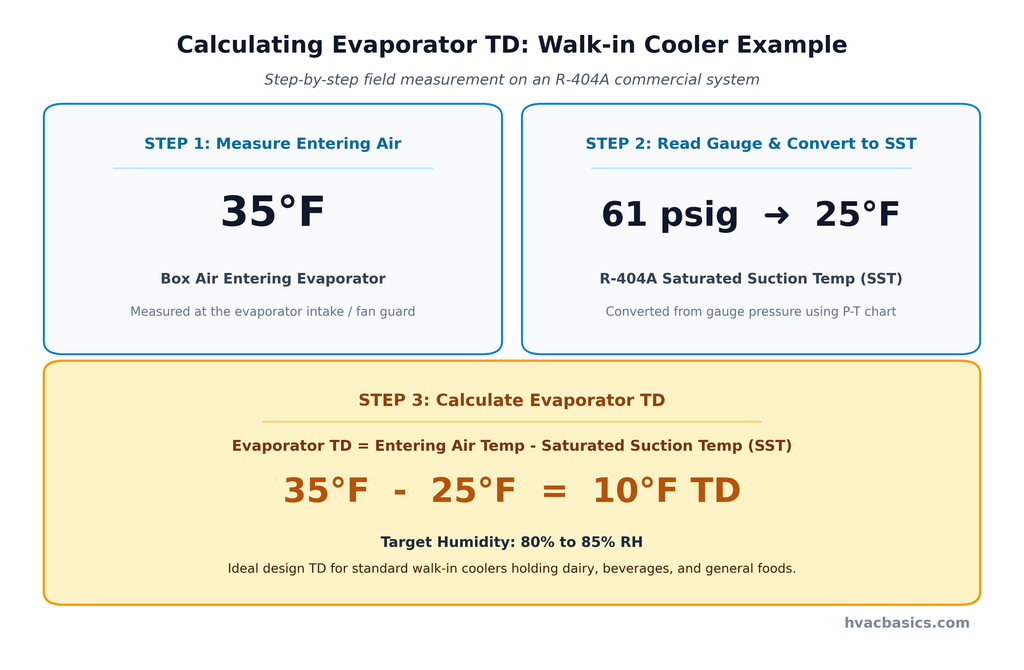
Evaporator TD = Entering Air Temperature (Box Temp) – Saturated Suction Temperature (SST)
You cannot read TD with a simple air thermometer alone. You need to know what the refrigerant is doing inside the tubes:
- Measure the suction pressure at the evaporator outlet (or suction service valve).
- Convert that pressure to saturation temperature using a P-T chart (Saturated Suction Temperature, or SST).
- Measure the temperature of the air entering the coil (the box temperature).
- Subtract SST from the entering air temperature.
Walk-in Cooler Example
- Box air entering the coil: 35°F
- Suction pressure on R-404A: 61 psig, which converts to 25°F SST
- TD=35°F – 25°F = 10°F TD
Why Evaporator TD Dictates Box Humidity
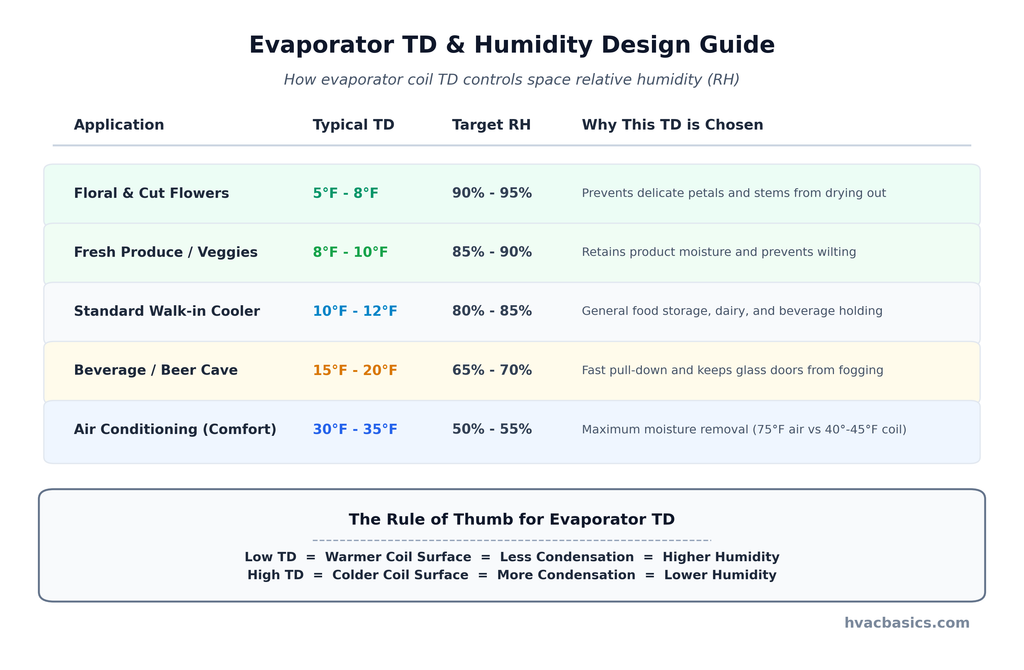
In comfort air conditioning, evaporators are typically selected for a 35°F to 40°F TD (75°F return air minus 40°F coil temp = 35°F TD) because we want maximum moisture removal.
In commercial refrigeration, the evaporator TD is specifically selected to control the humidity inside the walk-in or reach-in box:
- Low TD (5°F to 8°F): Keeps the coil surface temperature closer to the room air temperature. Because the coil is not drastically below the dew point, very little water condenses on the fins. This maintains high relative humidity (90% to 95%), which is necessary for fresh flowers, leafy greens, and unpackaged vegetables so they do not dry out and wilt.
- Standard Medium TD (10°F to 12°F): The industry standard for walk-in beer and dairy coolers, packaged goods, and general food storage. Maintains roughly 80% to 85% relative humidity.
- High TD (15°F to 22°F): Runs a very cold coil surface relative to the room air. The cold coil strips moisture aggressively, lowering relative humidity down to 50% to 60%. This is common in prep rooms, beer caves, or reach-ins where fog on glass doors must be avoided.
Quick Comparison Summary
| Metric | Formula | What It Measures | What Affects It |
|---|---|---|---|
| Delta T (ΔT) | Entering Air Temp – Leaving Air Temp | Air temperature drop across the coil | Airflow volume (CFM), fan speed, coil cleanliness, latent heat load |
| Evaporator TD | Entering Box Temp – Saturated Suction Temp (SST) | Thermal driving force between air and refrigerant | Coil physical surface area, box load, metering device feed, box humidity design |
Summary Field Rule
- Check Delta T to verify if air is moving through the coil properly.
- Check Evaporator TD to verify whether the refrigeration system is matched to the product and maintaining the proper box humidity.